
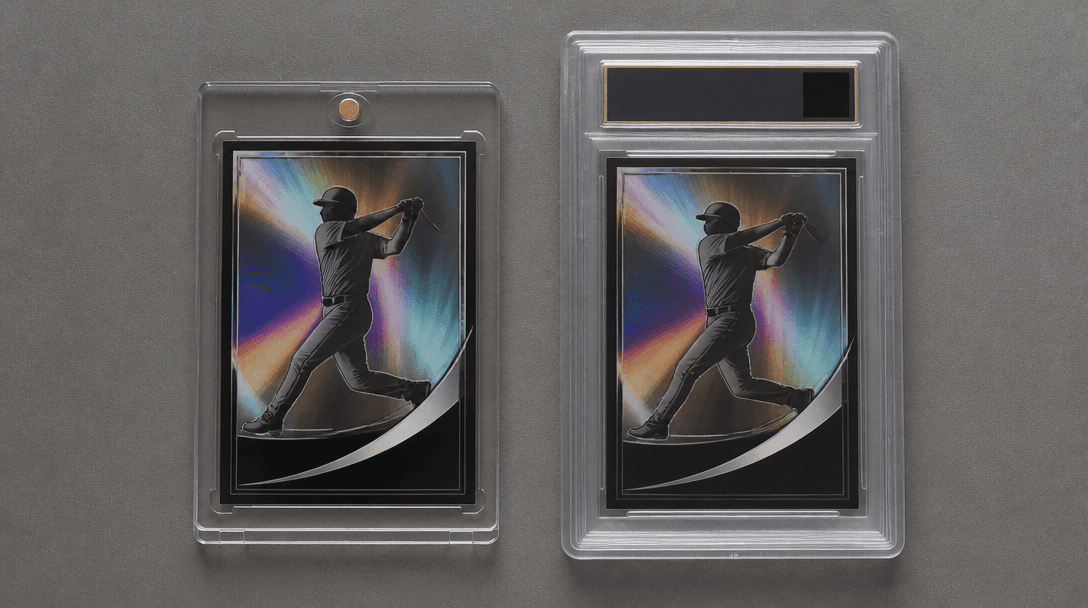
What a custom card is
A custom card is one you make. You start with your own photo, pick a template, add a name and details, and have it printed on trading card stock. It did not exist before you created it.
The point of a custom card is personalization — a card of your kid, your team, or yourself. Its value is in what it represents, not in a market price.
What a graded card is
Grading is a different activity entirely. You take an existing card — a retail or vintage card — and send it to a grading company such as PSA, BGS, or SGC.
They inspect it for centering, corners, edges, and surface, assign a condition grade (often on a 1 to 10 scale), and seal it in a tamper-proof case called a slab. Grading does not create a card; it authenticates and rates one that already exists.
Different purposes
The two answer different needs. Custom cards are for celebrating a person — a keepsake, a gift, team merchandise. Graded cards are for the collector market, where a verified condition grade affects what a card is worth.
You would never grade a custom card of your kid in the collector sense; there is no market price to protect. And you cannot make a graded card from scratch — grading is something done to a card that exists.
Where the confusion comes from
Some custom card makers offer a slab-style case — a hard plastic display case that resembles a graded card slab. It looks the part, and it is a nice way to present a custom card.
But the slab look is presentation, not certification. A custom card in a slab-style case has not been graded by PSA or anyone else. Snapshot cards, for comparison, ship in a magnetic display case that is easy to open and reposition.