
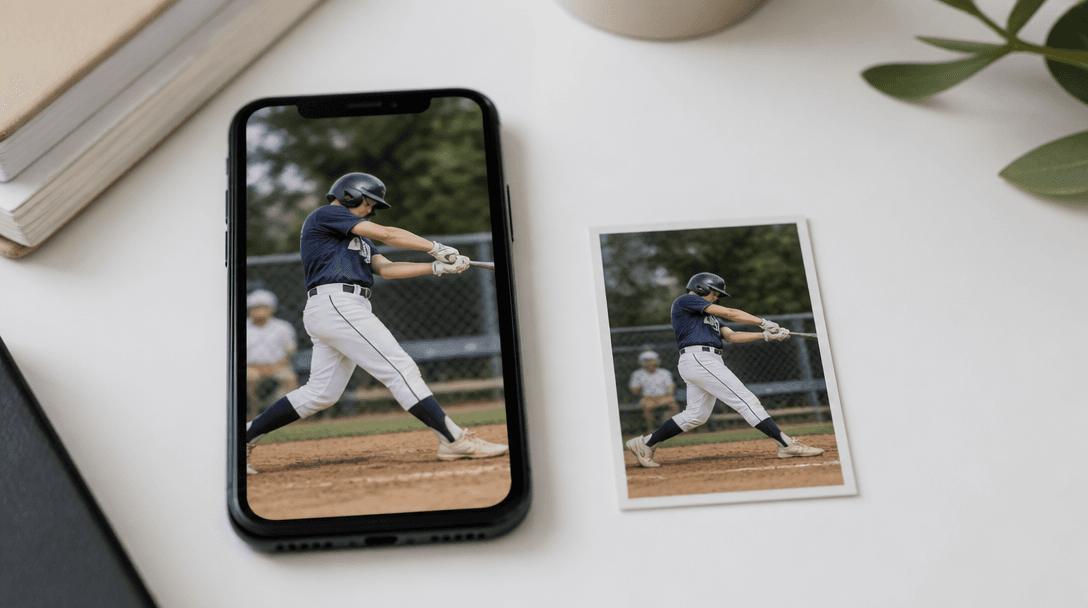
What kinds of photos work
The short answer is most of them. Action shots, posed portraits, team photos, even an old printed photo you scanned — all of these can become a card. What matters is not the subject but the quality.
A photo works best when it is in focus, evenly lit, and high enough resolution to print sharply. Photos that struggle are the very dark ones, the heavily blurred ones, and tiny low-resolution images pulled from social media.
- ✓Action sports shots — the most popular and most dynamic
- ✓Portraits and headshots in uniform
- ✓Team and group photos
- ✓Senior photos, recital shots, and milestone moments
How the photo becomes a card
You do not redraw or redesign anything. You upload the photo, crop it to frame the subject, and pick a template. The template is the design — borders, effects, name plate, stat layout — and your photo simply fills the frame.
From there you add text: a name, a number, a team, a year. Preview the result, adjust the crop if needed, and the card is ready to print.
What you actually get
The finished product is a physical card, not a download. It prints at the standard trading card size of 2.5 by 3.5 inches on official trading card stock with a high-gloss finish, and ships in a magnetic display case.
It has real weight and snap in hand — the same feel as a card off a retail shelf. That tangibility is the whole appeal of turning a photo into a card rather than just keeping it on a phone.
Photo resolution and file tips
Print is less forgiving than a screen, so resolution is the one technical thing worth checking. Use the largest, original version of the photo — not a screenshot or a compressed copy from a text thread.
- ✓Aim for a photo at least 1000 pixels on the short side; more is better.
- ✓Send the original file, not a screenshot of it.
- ✓JPG, PNG, and HEIC are all accepted.
- ✓If the photo looks soft or pixelated on your screen, it will look the same in print.