
What card stock actually is
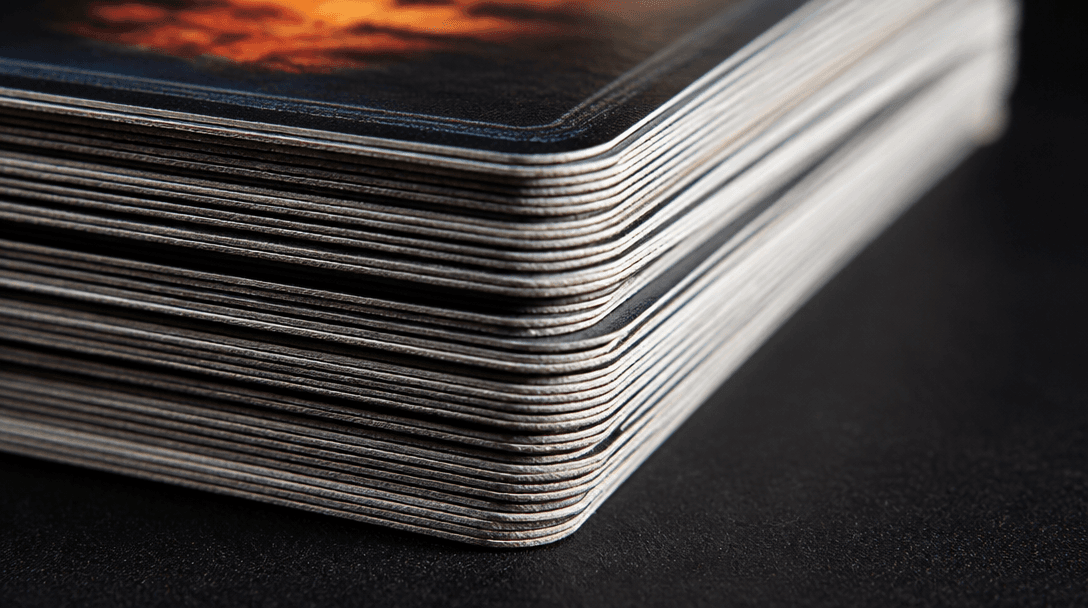
Card stock is a thick, sturdy paperboard — far heavier and more rigid than the paper in a printer or a notebook. Trading card stock is often built from layered sheets pressed together, sometimes with a thin core layer in the middle, then coated with a finish.
That construction is what makes a trading card feel like a trading card: stiff enough to hold its shape, with a satisfying snap when you flex it gently.
Why it matters for custom cards
This is one of the clearest dividing lines between a real custom card and a cheap one. Some makers print on thin paper or basic photo paper and call it a card. It is not — it bends, it creases, and it feels like what it is.
A quality custom card prints on official trading card stock, the same kind of material the major card brands use. That is why a Snapshot card has the heft and rigidity of a card off a retail shelf.
Finish: gloss and beyond
On top of the stock sits the finish. A high-gloss finish is standard on quality cards — it makes colors pop, adds a slight sheen, and protects the surface.
Premium finishes go further: foil adds a metallic shine, holographic adds shifting color. But all of them start with proper card stock underneath. The finish is the surface; the stock is the foundation.
How to tell good stock from bad
You usually cannot tell card stock quality from a website photo, so look at how a maker describes it. Vague language is a warning sign.
- ✓Look for makers that specifically say official trading card stock.
- ✓A real card has noticeable weight and stiffness — it should not flop.
- ✓Photo-paper prints crease and curl; card stock holds its shape.
- ✓A protective case included with the card is another sign the maker treats it as a real card.